Caring by Noddings Nel
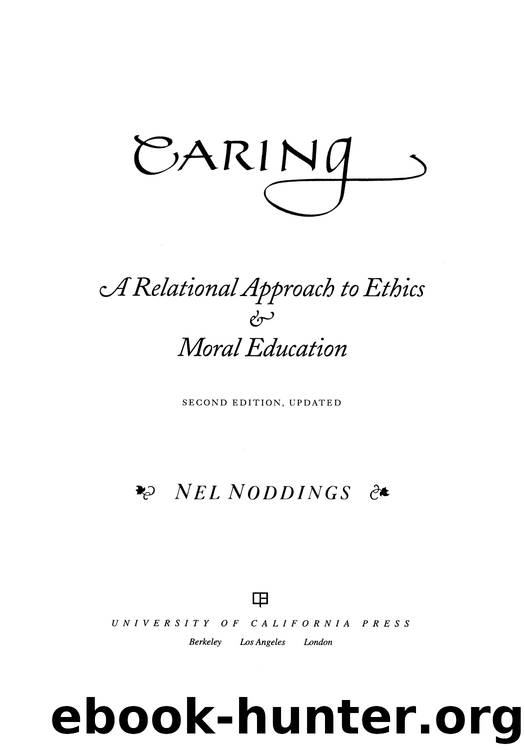
Author:Noddings, Nel
Language: eng
Format: epub
ISBN: 9780520275706
Publisher: University of California Press
CONSTRAINTS AND ATTAINABILITY
Now we want to ask why the ethical ideal must drag about—like Marley’s ghost with its chain of coin boxes and keys—all of the past deeds of its moral agent. It must do this to avoid self-deception and to remain in contact with what is. Since the locus of ultimate decisions concerning true-false and right-wrong is in the internal dialogue of the one-caring, self-deception has the potential to destroy the ethical ideal. The one-caring, then, must look clearly and receptively on what is there-in-herself. This does not mean that she must spend a great deal of time self-indulgently “getting to know” herself before reaching out to others. Rather, she reflects on what is inside as she relates to others. Reflection sometimes produces a revelation. The one-caring sees herself as having been jealous, or small-minded, or greedy. She sees this; she does not approve it, but she accepts it. So this dwells in me also, she acknowledges. She does not flagellate herself with these failings and clutch them to her bosom in some ecstasy of guilt, but she notes them with raised eyebrow and heightened wariness. This is here-in-me, and I must keep an eye on it as on a predisposition to backache or heart disease.
Construction and acceptance of the constrained ideal keep the one-caring close to the concrete. As she is tempted to soar into clouds of abstraction—where everything but gross contradiction can be set right—she is reminded by the weight of her Marley’s chain of who is speaking. It is she, this real creature with flawed ideal. How lovely she would be without the flaws! But this is nonsensical yearning. The flaws are earned and permanent. The task now is to confine them and stem their increase. Acceptance of the constrained ideal is one element in the requirement to connect the descriptive and prescriptive parts of the ethic. One must not push the moral agent into artificial solutions contrived in a parallel world of abstraction.
Like Nietzsche’s new philosopher, we are of “yesterday and tomorrow.” From our yesterdays we accept the earned constraints upon our ideal. Toward our tomorrows we fashion what may be attained. The requirement of attainability is as important as that of constraint. Indeed, it is a forward-looking set of constraints. It is not necessary that I, a concrete moral agent, actually attain my ideal—surely, I shall fail repeatedly—but the ideal itself must be attainable in the actual world. It must be possible for a finite human being to attain it, and we should be able to describe the attainment. The attainment must be actually possible; that is, if I am faithful and energetic and fortunate, I should be able to attain it in my actual relations with actual persons. I should not be diverted into abstraction and the endless solution of hypothetical problems.
Ms. A recounts an experience she had as a graduate student. The time was the late sixties, a time of antiwar sentiment and strong feeling for civil rights at home. A problem
Download
This site does not store any files on its server. We only index and link to content provided by other sites. Please contact the content providers to delete copyright contents if any and email us, we'll remove relevant links or contents immediately.
| Anthropology | Archaeology |
| Philosophy | Politics & Government |
| Social Sciences | Sociology |
| Women's Studies |
The remains of the day by Kazuo Ishiguro(8999)
Tools of Titans by Timothy Ferriss(8393)
Giovanni's Room by James Baldwin(7346)
The Black Swan by Nassim Nicholas Taleb(7129)
Inner Engineering: A Yogi's Guide to Joy by Sadhguru(6793)
The Way of Zen by Alan W. Watts(6614)
The Power of Now: A Guide to Spiritual Enlightenment by Eckhart Tolle(5781)
Asking the Right Questions: A Guide to Critical Thinking by M. Neil Browne & Stuart M. Keeley(5775)
The Six Wives Of Henry VIII (WOMEN IN HISTORY) by Fraser Antonia(5515)
Astrophysics for People in a Hurry by Neil DeGrasse Tyson(5189)
Housekeeping by Marilynne Robinson(4446)
12 Rules for Life by Jordan B. Peterson(4304)
Ikigai by Héctor García & Francesc Miralles(4274)
Double Down (Diary of a Wimpy Kid Book 11) by Jeff Kinney(4271)
The Ethical Slut by Janet W. Hardy(4251)
Skin in the Game by Nassim Nicholas Taleb(4248)
The Art of Happiness by The Dalai Lama(4130)
Skin in the Game: Hidden Asymmetries in Daily Life by Nassim Nicholas Taleb(4006)
Walking by Henry David Thoreau(3962)
